Worth
Selling something is easy. Writing the listing is the part you put off.
- Role
- Founder · Product, design & iOS development
- Year
- 2026
- Status
- Live
- Focus
- AI product design, iOS (SwiftUI), Backend, App Store strategy
- Links
- App Store
In short
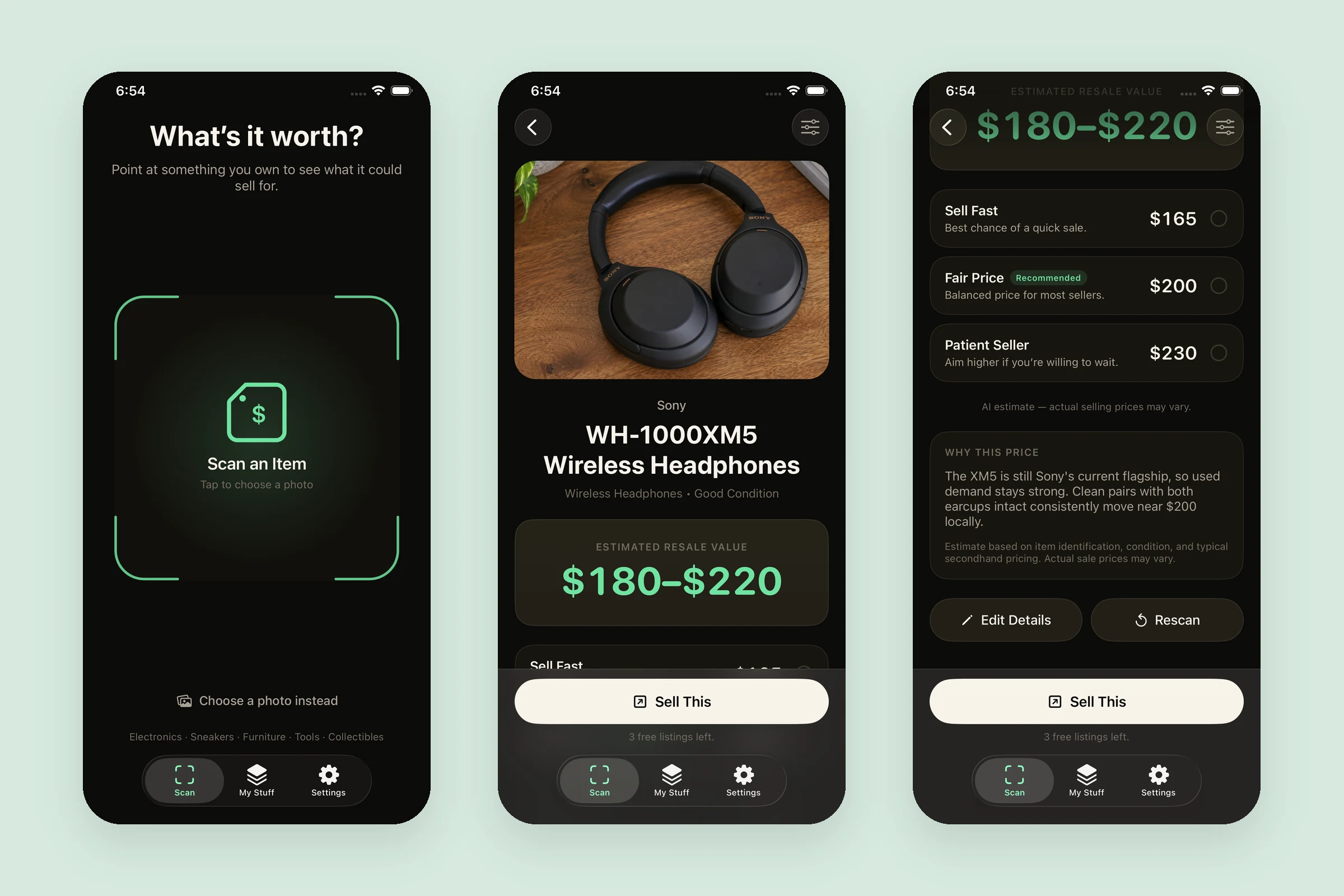
An iOS app that turns a photo of something you own into a priced, ready-to-post marketplace listing. It identifies the item, estimates a realistic resale range, offers three ways to price it, and writes the listing for wherever you’re selling — with no account.
At a glance
- Context
- Most people own things worth selling, and don’t — because pricing and describing them is a chore.
- Problem
- Valuation apps stop at a number. The work people actually avoid is the listing: a fair price, an honest description, written for the right marketplace.
- My role
- Solo: product, interface, the SwiftUI app, the backend that holds the AI and prompts, and the App Store submission.
- Outcome
- Live on the App Store since September 2026, after a rejection taught me how to describe what it actually does.

Approach
- 01
A listing, not a number.
The estimate is a means to an end. Worth writes a title, an asking price, and a description — and the wording changes with the destination, because what works on eBay isn’t what gets a reply on Facebook Marketplace.
- 02
Three prices, not one.
Sell Fast, Fair Price, or Patient Seller. People sell for different reasons, so the app asks how you want to sell instead of pretending there’s one right price. The listing is written to the one you pick.
- 03
Only claim what it can support.
Low-confidence identifications are labelled, and any detail can be corrected — the estimate follows the correction. Listings never invent accessories, wear, or a box. Jewellery, art, and anything that rests on authentication get a recommendation to see a professional.
- 04
No accounts, nothing kept.
Your inventory, values, and listings stay on your iPhone. The scan photo is analysed and not stored. Scanning is free and unlimited; Pro is a one-time purchase for unlimited listings.
Execution
A native app with nothing secret inside it.
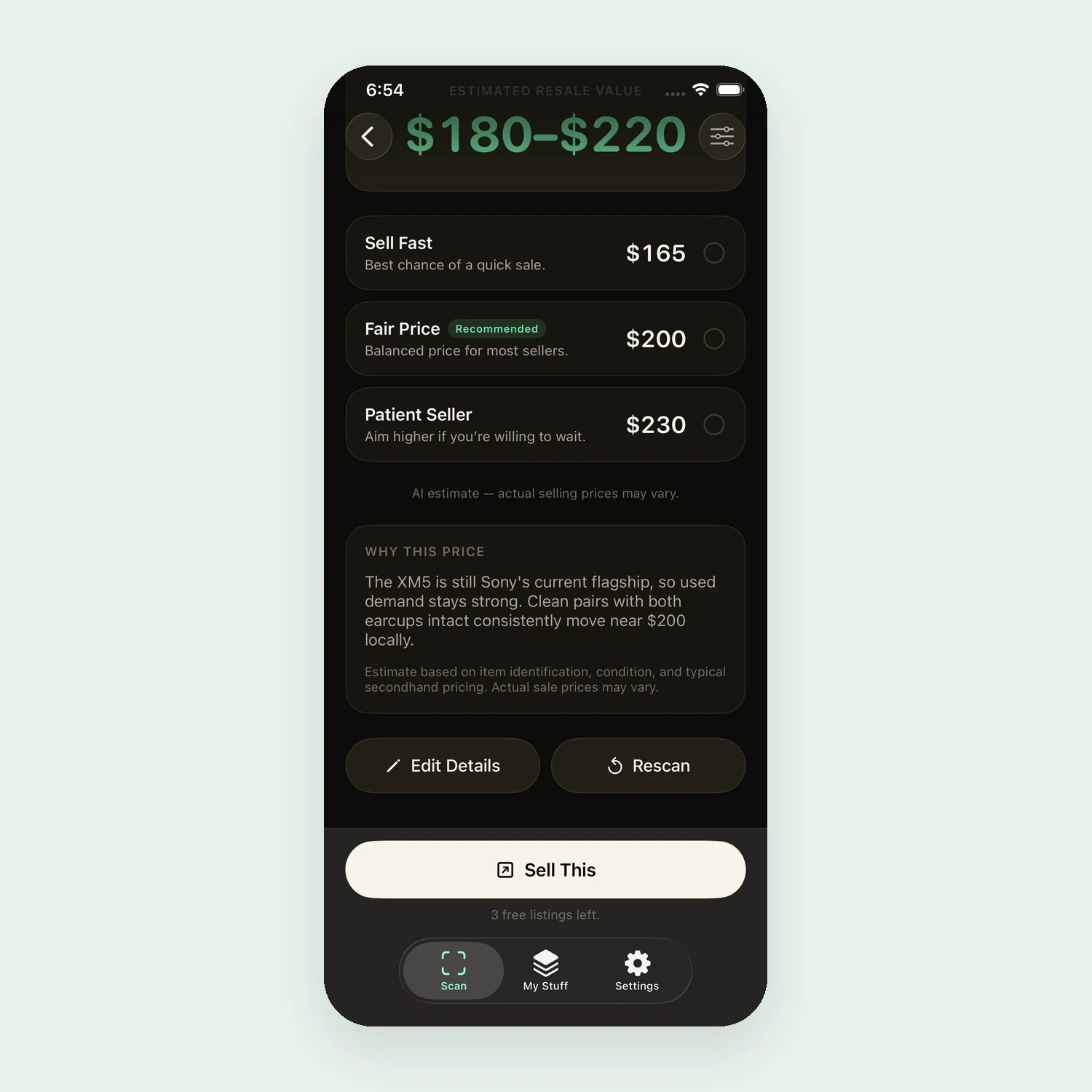
The app is native SwiftUI with a local inventory — “My Stuff” — that keeps a running total of what your things are worth. The AI and its prompts live on a separate backend, so the app ships no credentials and the prompts can improve without an app update.
Estimates are a range built from the photo, the item’s apparent condition, and typical secondhand pricing. Worth says plainly what that is and isn’t: not live listings, not sold comparables, not an appraisal.
Outcome
Apple rejected it until I described it accurately.
The first submission was rejected as too similar to other apps. It wasn’t a code problem: the listing had described Worth as a camera that scans and values your things — which is what many apps claim. What Worth actually does differently is write the listing.
I resubmitted the same build with the positioning rewritten around that — subtitle, description, keywords, and screenshot order — and it was approved. The lesson carried into every product since: the first job of the copy is to say what’s actually different.
LORE
A field guide to stones — honest about what a photograph can tell you.